Gru Languages
Gru Languages
Making lessons enjoyable, low-prep and full of opportunities for natural language use!
Our curriculum is designed to support young learners from preschool to A2 with a balanced mix of vocabulary, grammar and real-world communication skills. Each level follows international CEFR standards, giving teachers a clear, structured pathway while keeping lessons playful and engaging.
At the heart of our approach is the belief that children learn best through meaningful interaction. That’s why our resources emphasise learning through play, creative expression and communication-focused activities. From storytelling cards and role-play games to craft tasks, vocabulary puzzles and online fluency activities, every resource is made to help learners use English actively, confidently and with curiosity.
The aim is simple: to make lessons enjoyable, low-prep and full of opportunities for natural language use.
Curriculum Overview
Click image to zoom
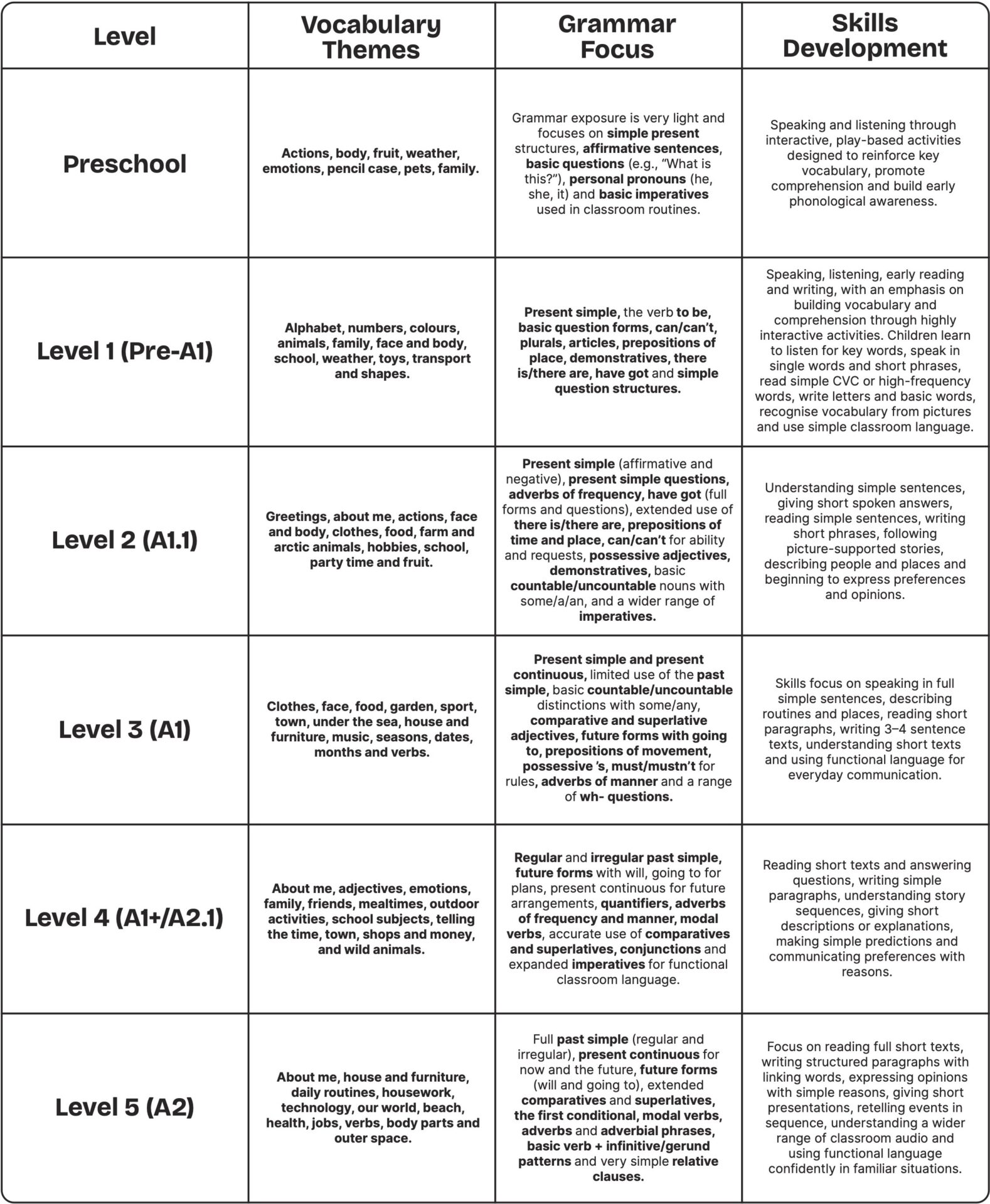
Actions, body, fruit, weather, emotions, pencil case, pets, family.
Grammar exposure is very light and focuses on simple present structures, affirmative sentences, basic questions (e.g., “What is this?”), personal pronouns (he, she, it) and basic imperatives used in classroom routines.
Speaking and listening through interactive, play-based activities designed to reinforce key vocabulary, promote comprehension and build early phonological awareness.
Alphabet, numbers, colours, animals, family, face and body, school, weather, toys, transport and shapes.
Present simple, the verb to be, basic question forms, can/can’t, plurals, articles, prepositions of place, demonstratives, there is/there are, have got and simple question structures.
Speaking, listening, early reading and writing, with an emphasis on building vocabulary and comprehension through highly interactive activities. Children learn to listen for key words, speak in single words and short phrases, read simple CVC or high-frequency words, write letters and basic words, recognise vocabulary from pictures and use simple classroom language.
Greetings, about me, actions, face and body, clothes, food, farm and arctic animals, hobbies, school, party time and fruit.
Present simple (affirmative and negative), present simple questions, adverbs of frequency, have got (full forms and questions), extended use of there is/there are, prepositions of time and place, can/can’t for ability and requests, possessive adjectives, demonstratives, basic countable/uncountable nouns with some/a/an, and a wider range of imperatives.
Understanding simple sentences, giving short spoken answers, reading simple sentences, writing short phrases, following picture-supported stories, describing people and places and beginning to express preferences and opinions.
Clothes, face, food, garden, sport, town, under the sea, house and furniture, music, seasons, dates, months and verbs.
Present simple and present continuous, limited use of the past simple, basic countable/uncountable distinctions with some/any, comparative and superlative adjectives, future forms with going to, prepositions of movement, possessive ’s, must/mustn’t for rules, adverbs of manner and a range of wh- questions.
Skills focus on speaking in full simple sentences, describing routines and places, reading short paragraphs, writing 3–4 sentence texts, understanding short texts and using functional language for everyday communication.
About me, adjectives, emotions, family, friends, mealtimes, outdoor activities, school subjects, telling the time, town, shops and money, and wild animals.
Regular and irregular past simple, future forms with will, going to for plans, present continuous for future arrangements, quantifiers, adverbs of frequency and manner, modal verbs, accurate use of comparatives and superlatives, conjunctions and expanded imperatives for functional classroom language.
Reading short texts and answering questions, writing simple paragraphs, understanding story sequences, giving short descriptions or explanations, making simple predictions and communicating preferences with reasons.
About me, house and furniture, daily routines, housework, technology, our world, beach, health, jobs, verbs, body parts and outer space.
Full past simple (regular and irregular), present continuous for now and the future, future forms (will and going to), extended comparatives and superlatives, the first conditional, modal verbs, adverbs and adverbial phrases, basic verb + infinitive/gerund patterns and very simple relative clauses.
Focus on reading full short texts, writing structured paragraphs with linking words, expressing opinions with simple reasons, giving short presentations, retelling events in sequence, understanding a wider range of classroom audio and using functional language confidently in familiar situations.

Love the creative designs of Gru languages, a great aid for the classroom. Students love the designs and it helps to make learning English more fun! – Lisa

Love these activities. I can never find enough hands on materials for my efl courses and now I’m set! – Heather

I have been using Gru Languages’ teaching resources for years now with my young students and my own children. They all love the activities, games and crafts designed by Sarah. It has been a precious time-saving teaching tool when I taught children face-to-face. It is now a perfect way to offer a large choice of thematic activities to my online students. – Margot, English teacher and Founder of lessons4kids.net

As a school owner andteacher I have found the Gru worksheets and games to be a fantastic addition to our syllabus. They are creative and fun and are really popular with the kids – Zara, www.theenglishstudio.org
PRICING PLANS

Online Games
Only ~$5.33 per month!
 Unlimited access to 60+ online games and activities. Perfect for online lessons and interactive whiteboards
 40+ topicsNew games added weeklyFull email supportIndividual license
 Please note that this plan does not include the printable worksheets
Lesson Materials
Only ~$6.67 per month!
Unlimited access to 2200+ professionally designed printable classroom activities, games and crafts200+ lesson plans200+ flashcardsNew content added weeklyNo download limitIndividual licenseFull email support
Online Games +
Lesson Materials
Only ~$9.33 per month!
Unlimited access to 2200+ professionally designed printable activities, games and craftsUnlimited access to 60+ online games and activities200+ lesson plans200+ flashcardsNo download limitNew content and games added weeklyIndividual licenseFull email supportSchools
Only ~$27.58 per month!
Unlimited access to 2200+ professionally designed classroom activities, games and craftsUnlimited access to our online game libraryUp to 8 user accounts200+ Lesson plans200+ FlashcardsNo download limitNew content and games added weeklyFull email support